
Products
Start with the work. Then explain the AI.
How we introduced Yadi through the everyday customer conversations a business already understands, instead of making the technology the whole story.

A familiar starting point
A customer asks whether something is available. Another wants to know about delivery. The business owner is trying to reply while getting on with the work that made the business worth contacting in the first place.
That is a more useful introduction to Yadi than a list of AI capabilities. Yadi is Embiro’s AI helper for the everyday customer conversations a small business handles on WhatsApp. Its public story starts with the person doing that work and the support they could use.
The line “Your business, with backup” gives that relationship a simple shape. There is still a business, still an owner and still a way they want to speak to customers. The product is introduced as help with the conversation.
Show the role before explaining the machinery
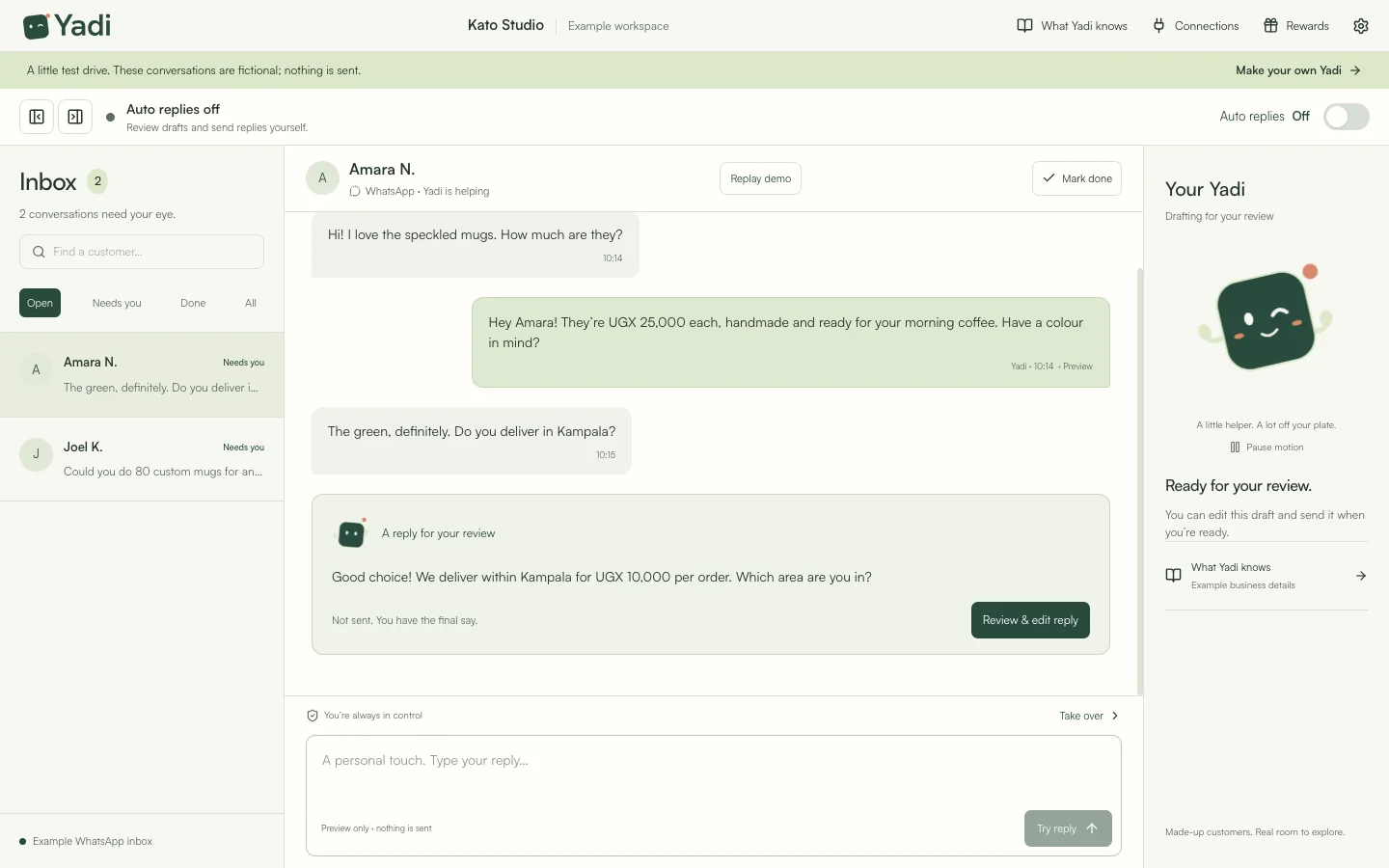
On the website, a human business story sits alongside a conversation example. The combination does two jobs. The person makes the context recognisable; the exchange gives the product a concrete role in that context.
They need to understand which part of their day it could help with.
A visitor should not need to understand a model, an integration or an internal workflow to decide whether a product is relevant. They need to understand which part of their day it could help with. Technical detail can follow once there is a reason to care.
This is also a useful discipline for product teams. If the first explanation needs several abstract terms, the job may not be clear enough yet. A small, specific example forces the introduction to say what changes for the person using it.
The business’s voice belongs in the promise
Customer conversations are part of how a business presents itself. An answer can contain the right information and still feel unlike the business that sent it. That makes voice and control part of the product story, rather than details to hide at the bottom of the page.
Embiro’s introduction to Yadi describes WhatsApp questions answered in the business’s voice, with the owner in control. Those are useful expectations to put in front of a prospective user. They also set a standard for the experience to live up to.
An example conversation helps explain the intention. It is not evidence that every future reply will be correct, or that a business can stop paying attention to its customers. The website needs to help people explore the product with a clear sense of its role, rather than promising that all the work disappears.
- Begin with a recognisable moment in the user’s day.
- Show the product doing one understandable job.
- Make the human role and the limits of the promise clear.
Leave room for the next question
A homepage is an introduction, not a complete product manual. Once the role is clear, people should have a straightforward way to explore how the product works and whether it fits their business.
For Yadi, the website connects that initial promise with routes into the experience. The visual story and the next action belong together: recognise the situation, understand the help and then investigate further.
The broader lesson is simple. When building an AI product, the technology may be the most interesting part to the team making it. For the person considering it, the most interesting part is often a familiar task becoming easier to handle. Start there.
Recognise the situation
Start with a customer question the business already handles.
Understand the help
Use one concrete example to show the product’s role.
Explore the fit
Give the owner a clear next step and room to ask questions.